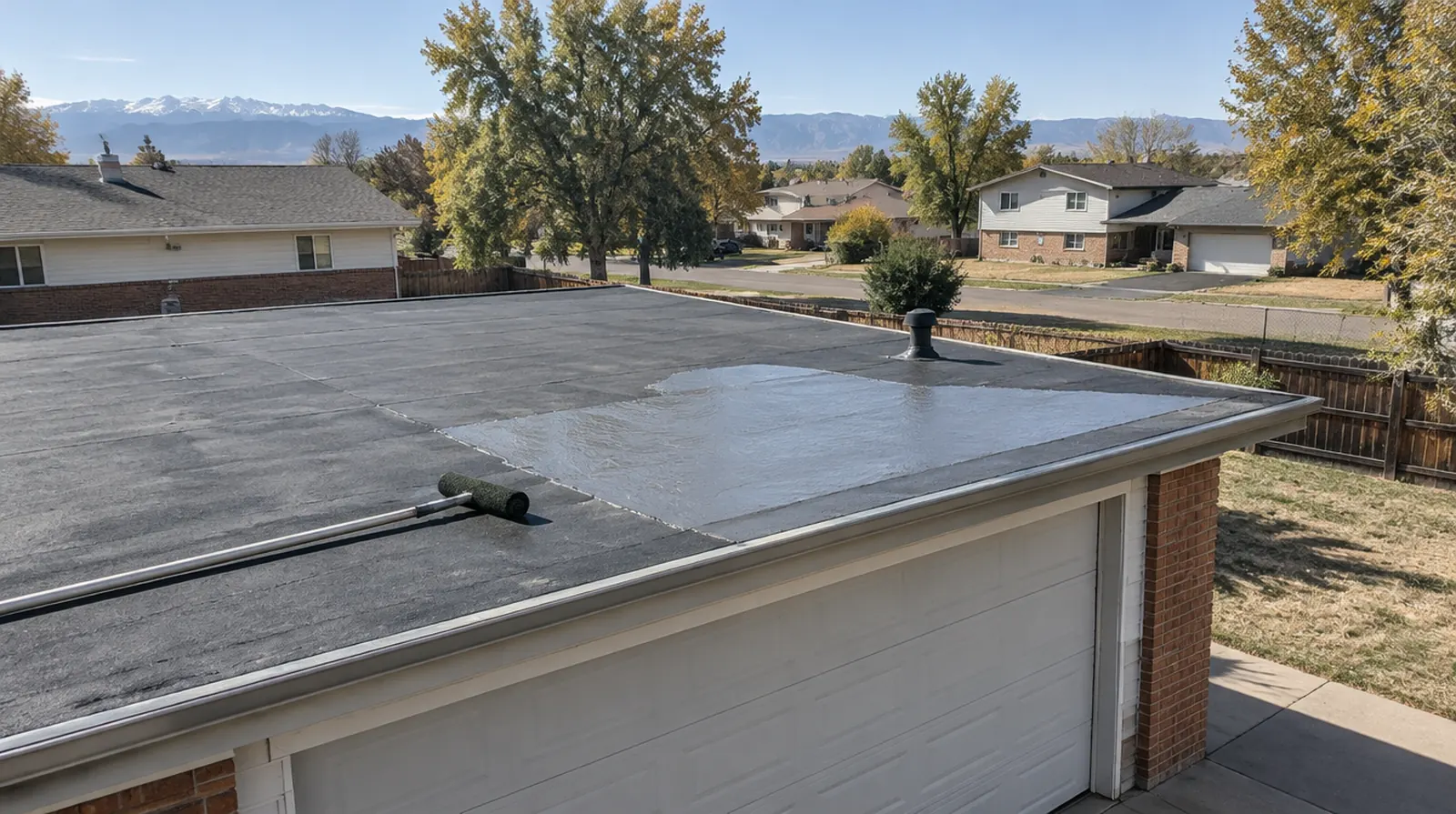
Flat roof repair across Commerce City
Most homes here have pitched shingle roofs, but plenty have at least one low section. Older ranches sometimes have a flat-roofed carport or room addition. Newer homes may have a low-slope covered patio or a section over a bay. Around the industrial and commercial areas near the rail yards and along the highway corridors, small buildings commonly use membrane roofs. All of these depend on good seams and drainage rather than steep pitch.
Signs a flat roof needs repair
- Water stays on the roof for days after a storm or snowmelt.
- The membrane is cracked, blistered, shrinking or pulling away at the edges.
- Seams have opened or patches are peeling.
- Hail has left punctures, dents or bruises in the surface.
- A ceiling below the low section is stained or sagging.
How we repair low-slope roofs
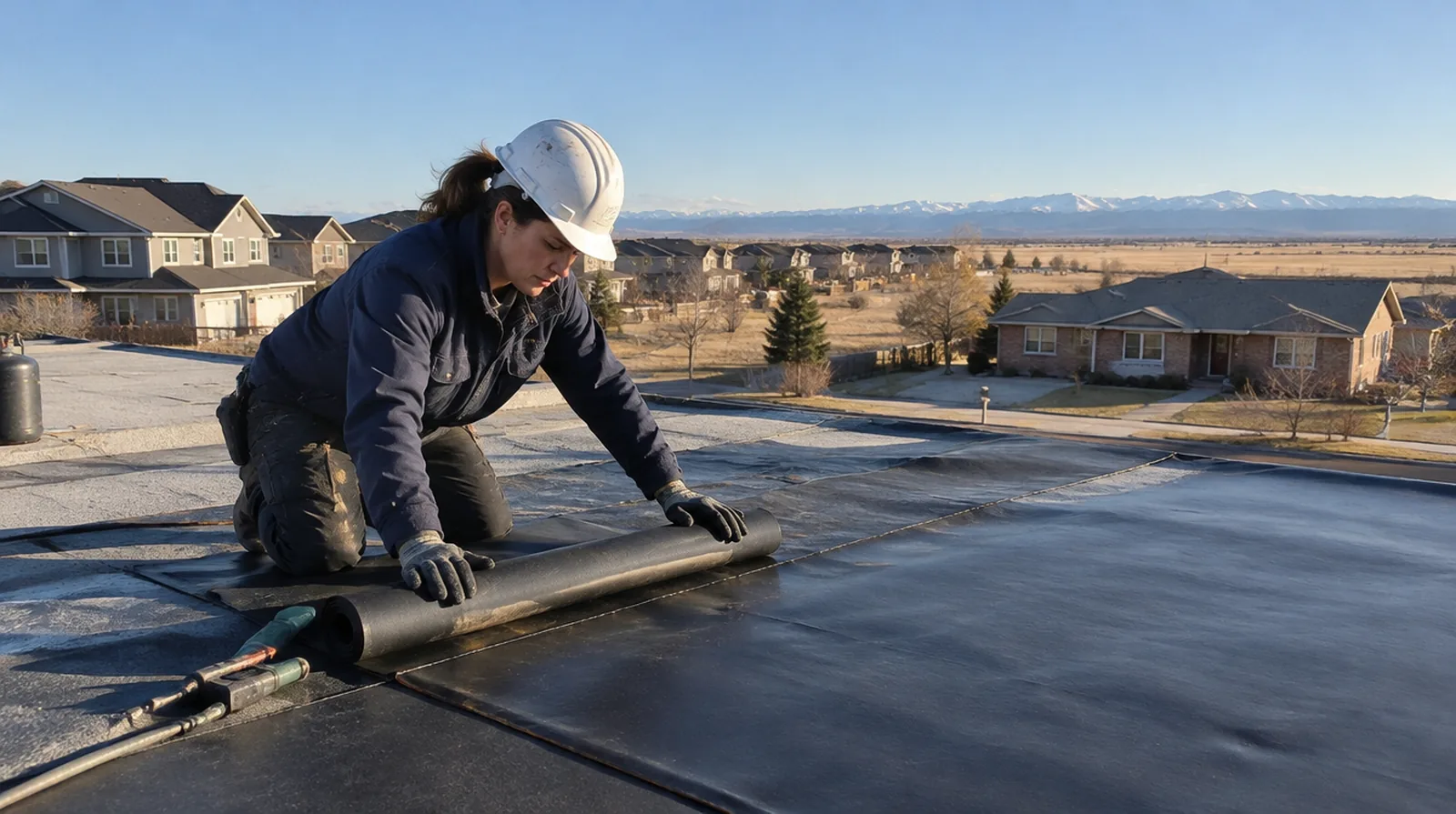
We start by clearing debris and finding where water collects or enters. Edges, seams, drains, scuppers and the joints where a low roof meets a wall are the usual suspects. We check for wet insulation or soft decking under the membrane, since water can travel before it shows inside.
Once the source is found, damaged membrane is cut out to sound material, the area is dried and a new patch is bonded in place. Open seams are cleaned and resealed. Wall and curb flashing is redone with new material. Drains and scuppers are cleared so water can leave the roof. If the deck under the damage is rotted, we replace that part first.
Why flat roofs struggle in this climate
Intense sun at this altitude breaks down membranes faster, causing shrinkage at the edges and cracking across the surface. Hail can puncture or bruise the membrane, especially older or thinner materials. Heavy spring snow sits on low roofs and melts slowly, keeping water on the seams for days. Big temperature swings make the membrane expand and contract, which stresses every seam and flashing joint.
What affects flat roof repair cost
- Membrane type. TPO, EPDM, modified bitumen and older built-up roofs each need different repair materials.
- Size of the damage. A single puncture is quicker than a large worn area.
- Wet materials. Saturated insulation or decking has to be removed and replaced.
- Flashing and edges. Rebuilding wall or edge details adds labor.
Spot repair versus a full recover
If the membrane is mostly sound and the trouble is a seam, a puncture or one bad drain, a targeted repair is usually enough. If hail has damaged the whole surface, the membrane is cracked everywhere, or several patches have already failed, replacing the membrane is often the better long-term choice. We look at age, overall condition and how much water is trapped underneath before giving you options.
Caring for a flat roof between repairs
Keep drains and scuppers clear of leaves and debris, especially in fall. Avoid walking on the membrane more than necessary, and never chip ice off with a shovel. After a significant hailstorm, have the low sections looked at along with the main roof, since punctures are easy to miss. A quick check each spring catches open seams before summer storms.
Low-slope roofs on patio covers and carports
Patio covers and carports often get built with very little slope and tied into the house wall with a simple strip of flashing. Over time that joint opens and water runs down the wall into the room behind it. When we repair these, we redo the wall flashing properly and check that the cover has enough pitch to drain toward the outer edge.
Flat roof repair FAQs
Can a coating fix my flat roof?
Coatings can extend the life of a sound membrane, but they do not fix wet insulation or open seams underneath.
Do you repair hail damage on flat roofs?
Yes, and we can document it for your insurance claim.
Do you work on small commercial buildings?
Yes, including low-slope sections on shops and offices.
How do I get started?
Call (720) 230-2809 to schedule a visit.
Have a low-slope leak?
Call (720) 230-2809 for a free flat roof repair look.